
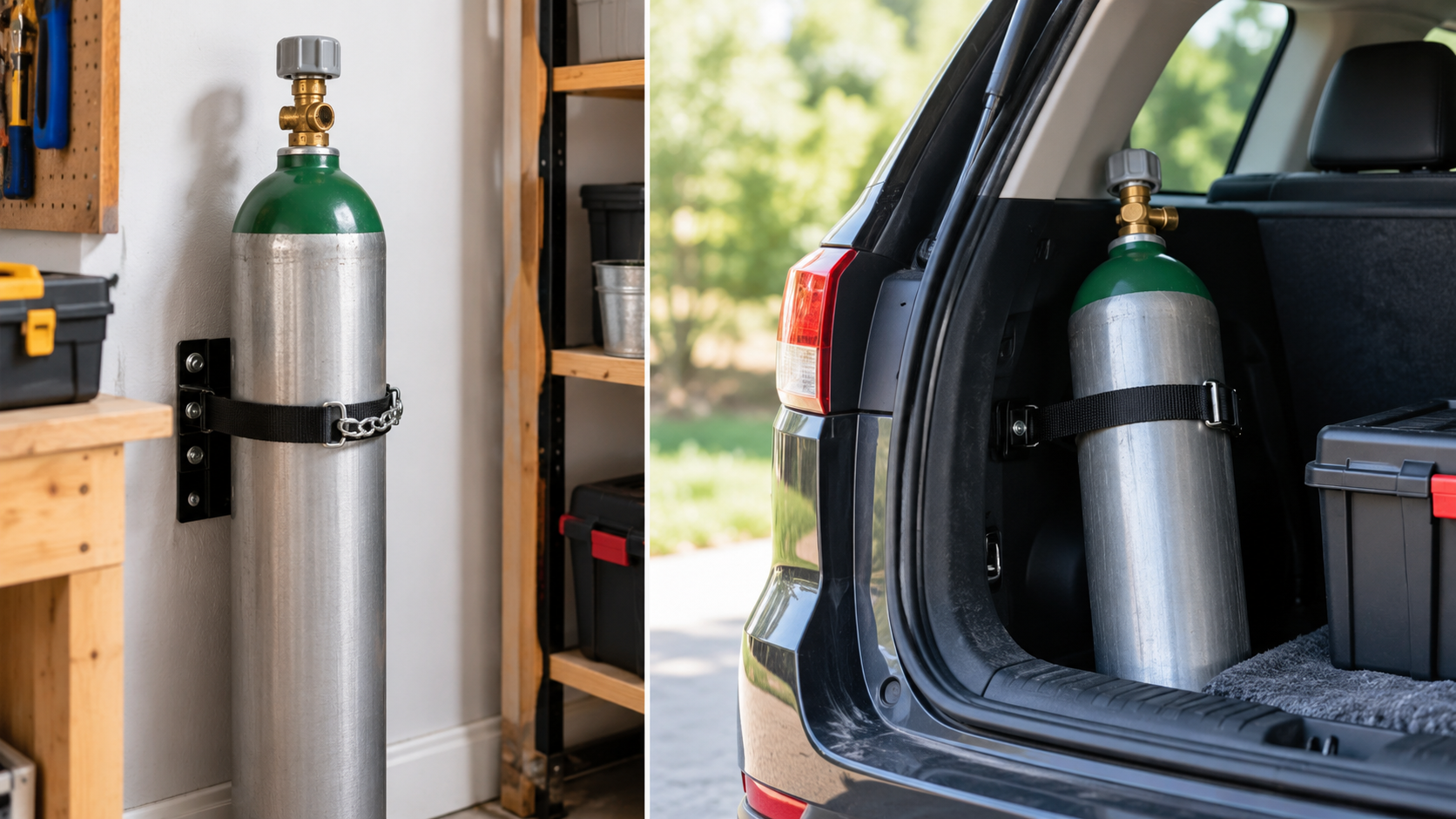
Whether you use CO₂ for a kegerator, home carbonation, a planted aquarium, welding, beverage dispensing, or another application, proper storage and transportation are important parts of taking care of your cylinder.
The good news is that CO₂ tank safety doesn't have to be complicated. A few simple habits can help protect the cylinder, its valve, and the people around it.
How to Store a CO₂ Tank Safely
The basic rule is simple: keep your CO₂ cylinder upright, secured, protected from heat, and in a well-ventilated area.
Keep the Cylinder Upright and Secure
CO₂ cylinders should be kept upright and secured so they cannot easily tip or fall.
A suitable wall bracket, chain, strap, cylinder stand, or rack can help keep the cylinder in place. Simply leaning a cylinder against a wall isn't the same as properly securing it.
Keeping the cylinder upright also helps protect the valve at the top of the tank from being damaged.
Keep CO₂ Tanks Away From Heat
Avoid storing a CO₂ cylinder next to heaters, furnaces, radiators, or other sources of excessive heat. Direct sunlight should also be avoided.
This is especially important during the warmer months. A cylinder sitting in direct sunlight or a hot enclosed area can become significantly warmer than the surrounding environment.
If you're interested in how temperature can affect your refill, see our article “Getting a CO₂ Refill? Don't Let a Warm Cylinder Add to Your Wait.”
Choose a Dry, Well-Ventilated Location
A suitable garage, workshop, utility area, or other storage space can work well as long as the area is dry and appropriately ventilated.
CO₂ is heavier than air. If a significant amount were to escape, it can collect in low or poorly ventilated areas. Good ventilation helps reduce this concern.
Avoid storing a cylinder in a small, enclosed space where there is little air movement.
Protect the Valve
The valve is one of the most important parts of the cylinder to protect.
When the cylinder isn't connected to your equipment, keep the valve protected as appropriate for the cylinder. Don't use the valve as a handle, and don't attempt to repair or modify a damaged valve yourself.
If you notice a damaged cylinder or signs of a leak, don't ignore it. Move away from the area and seek appropriate assistance.
Keep the Area Around the Cylinder Clear
Try to keep tools, boxes, equipment, and other objects from being piled around the cylinder.
A clear area makes it easier to inspect the tank, access the valve, and move the cylinder safely when it's time for a refill or testing.
How to Transport a CO₂ Tank
Many CO₂ users regularly transport their cylinders to a refill or testing facility. Whether you're taking a tank to Rapid CO₂ in Nepean or bringing one home after a refill, the same basic principles apply.
Secure the cylinder, protect the valve, and avoid unnecessary heat or impacts.
Don't Let the Cylinder Roll Around
A CO₂ cylinder shouldn't be allowed to roll freely around the back of a vehicle.
Secure it so it can't slide, tip over, or strike other objects during transportation. For larger cylinders, use an appropriate cylinder cart or hand truck when moving the tank rather than dragging or rolling it.
Take a little extra care when loading and unloading. Dropping a cylinder can damage the tank or valve.
Protect the Valve During Transport
When transporting a cylinder that isn't connected to equipment, protect the valve as appropriate for the cylinder.
Never carry a cylinder by its valve or use the valve as a convenient handle.
The goal is simple: keep the cylinder and valve protected from unnecessary bumps, drops, and other damage.
Don't Leave a CO₂ Cylinder Sitting in a Hot Vehicle
A vehicle can become very hot when parked in the sun.
If you're taking a CO₂ cylinder for a refill, testing, or service, avoid leaving it sitting in a hot vehicle longer than necessary. Plan your trip so the cylinder can be transported directly to where it needs to go.
This is particularly worth remembering during Ottawa's warmer summer months.
Check the Cylinder Before You Transport It
Before putting your CO₂ tank in your vehicle, take a quick look at it.
Check for obvious damage or anything that looks unusual. If the cylinder appears damaged or you suspect it may be leaking, don't simply put it in your vehicle and continue with your trip.
If you're unsure about the condition of your cylinder, have it looked at by a qualified CO₂ service provider.
What About an "Empty" CO₂ Tank?
An "empty" CO₂ cylinder should still be treated as a cylinder that requires proper handling.
Even when your tank is no longer supplying enough CO₂ for your equipment, continue to keep it secured and protect the valve.
When it's time for a refill, bring the cylinder to a facility that can inspect it and determine whether it is suitable for service.
Hydrostatic Testing: Required Every Five Years
Storage and transportation aren't the only things to consider when taking care of a CO₂ cylinder.
Hydrostatic testing is required every five years. The test helps confirm that the cylinder remains suitable for continued use.
Before heading out for a refill, check the hydro test markings on your cylinder. If the five-year testing period has passed, the cylinder will need to be hydrostatically tested before it can be refilled.
If you're not sure what the markings mean, our article “CO₂ Cylinder Sizes: How to Read Tank Markings” explains some of the common information stamped onto CO₂ cylinders, including the tare weight and hydro test markings.
Rapid CO₂ provides hydrostatic testing and recertification services at its Nepean facility.
A Few Simple CO₂ Safety Rules to Remember
If you only remember a few things, remember these:
Keep your CO₂ cylinder upright.
Secure it so it can't easily fall over.
Protect the valve.
Keep it away from excessive heat and direct sunlight.
Store it in a dry, well-ventilated area.
Don't drag, drop, or roll the cylinder unnecessarily.
Secure the cylinder when transporting it.
Don't ignore a damaged or leaking cylinder.
Remember that hydrostatic testing is required every five years.
Need a CO₂ Refill or Hydrostatic Testing in Ottawa?
If your CO₂ cylinder needs a refill or hydrostatic testing, Rapid CO₂ provides these services from its Nepean location and serves customers throughout Ottawa and the surrounding area.
Rapid CO₂ provides CO₂ cylinder refills and hydrostatic testing for applications including kegerators and draft systems, beverage carbonation, aquariums, and other CO₂ uses.
Before bringing your cylinder in, check its condition and hydro test markings. If you're unsure whether your tank is suitable for service, contact Rapid CO₂ at 613-299-8412.
Proper CO₂ storage and transportation are simple habits, but they can go a long way toward protecting your cylinder and keeping it ready for its next use.
